A scoped assessment covering the decisions you need before committing to a build.
Use-case discovery and prioritisation, ranked by value, feasibility and data readiness — not by trend.
Data readiness review: what data you have, what is missing, where it lives, and whether the first use case can work with available inputs.
Integration and permission mapping: which systems the workflow touches, who may access what, and where a human approval step is required.
Architecture and evaluation design: how the feature will be built, how its outputs will be checked, and what "working" means in measurable terms.
Rollout and iteration planning, including monitoring where the agreed scope covers it.
An assessment document: the ranked use cases, the architecture sketch and the go or no-go — written so your own team or another supplier could act on it. What else the assessment includes is agreed in scope before work begins.

Review business goals, data readiness and operational constraints to prioritise AI opportunities with clear, achievable outcomes — and to name the ones that are not worth building.
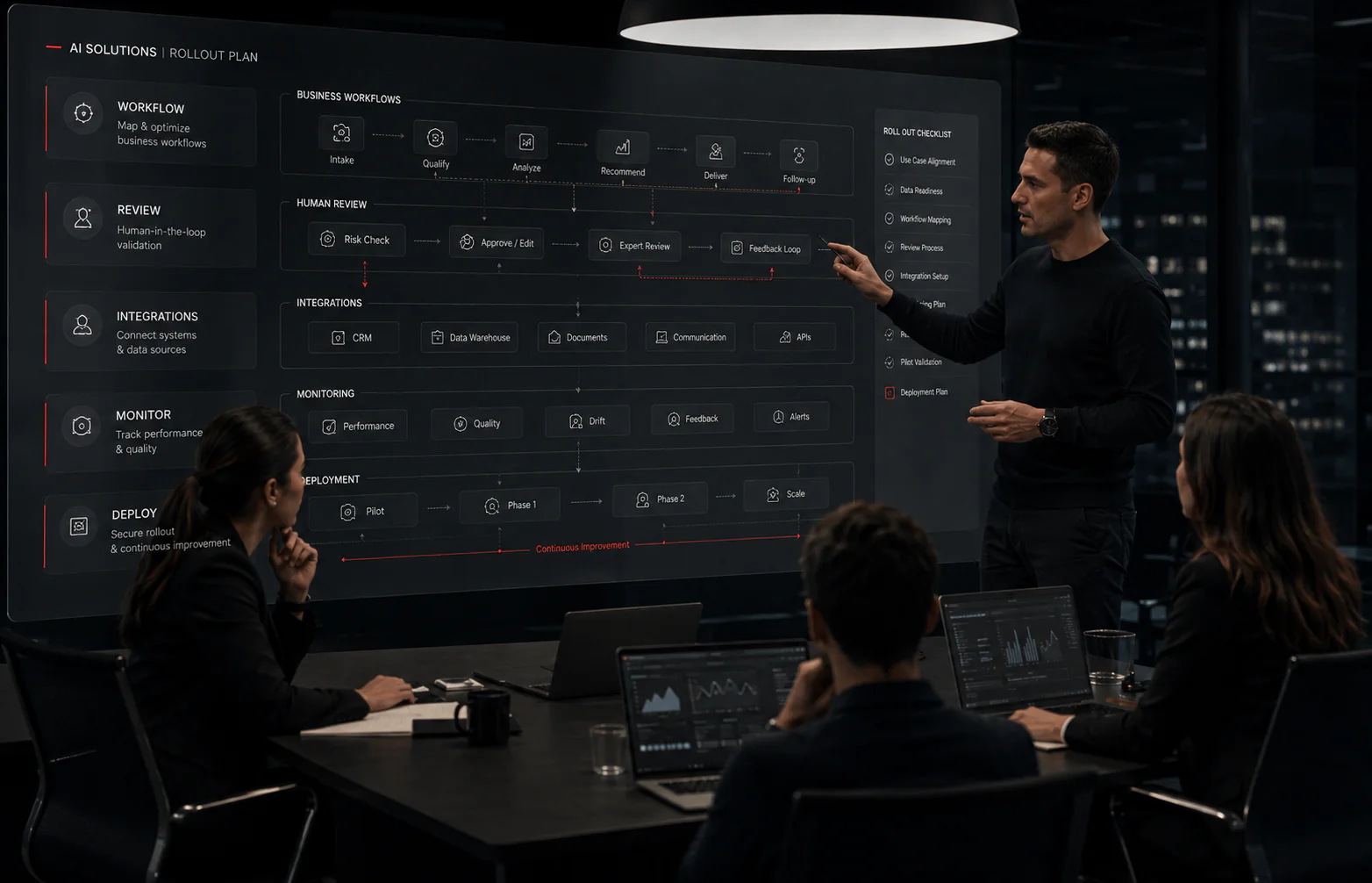
Map how people, tools and AI work together, including approval paths, failure handling and auditability, before any build begins.
If a pilot or prototype stalled, we review what worked, what blocked production — data, integration, permissions, evaluation or cost — and redesign the workflow or scope for a practical next step.
Four steps to a decision — not a generic launch path. This service ends at a go or no-go.
Clarify the business goal, the workflow, the users and the success measure.
Examine data, systems, permissions and constraints; test the riskiest assumption first.
Produce the workflow, architecture, evaluation approach and rollout sequence.
Present the go or no-go, the ranked next steps, and the scoped cost of the next phase — which may be a pilot, a build, an internal rollout, or a decision not to use AI.
Unclear where AI fits in existing operations
Pilots that never reach production
Teams adopting AI tools inconsistently or unsafely
Disconnected handoffs between AI outputs and downstream workflows
No visibility into whether an AI initiative is working
A use case chosen because it was fashionable, not because it was feasible
A ranked list of use cases with feasibility attached
A workflow designed around real business needs
A clearer path from pilot to production
Visibility into what would need to change before a build
A foundation for AI Development when the decision is "go"
A services firm wants an assistant that answers staff questions from internal documents. Assessment finds that half the documents sit in personal drives with no access controls, so a retrieval system would leak information between teams. The go decision is conditional: fix document permissions first, then pilot retrieval on one team's documents only, with citations and a "not found" answer. The alternative — building the assistant first and fixing permissions later — is rejected in writing. No outcome is claimed for this scenario, because it did not happen.
Explore selected client projects connected to this service area.
Planning AI features with a remote product team? See how we support US founders and UK founders.
Practical answers about how iCodeLTD scopes, delivers, and supports software projects for startups and growing businesses.
Not sure what is worth building, or why a pilot stalled? Start with a scoped assessment — ranked use cases, a systems review, and a go or no-go.