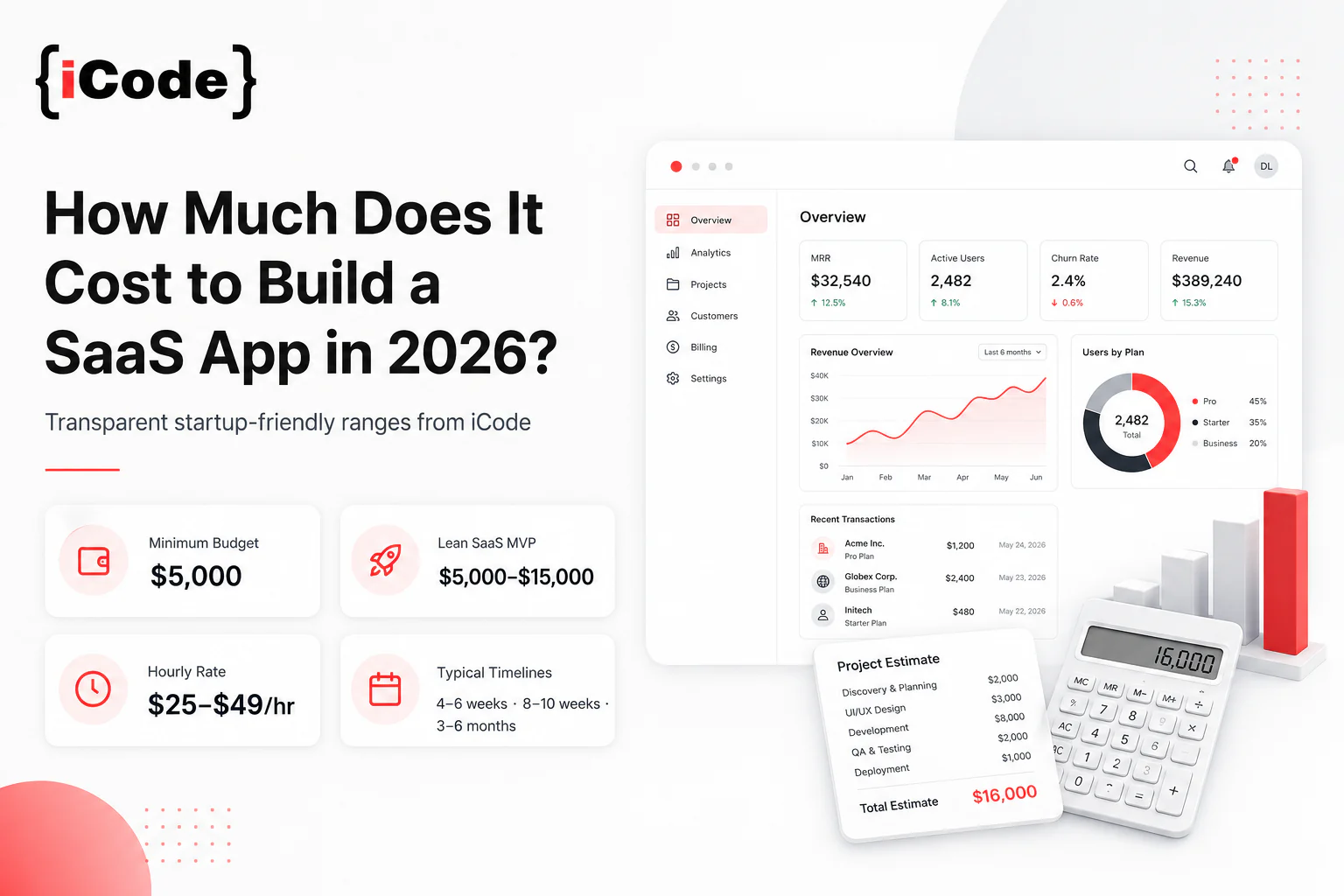
How much does it cost to build a SaaS app in 2026? For many founders, a lean SaaS MVP with a focused first-version scope may fall between $5,000 and $15,000 at iCodeLTD, depending on roles, features, integrations, design complexity, and launch requirements. Custom software projects usually start from $5,000, and the public hourly range is $25–$49/hour. These are planning ranges, not fixed quotes—final cost depends on product scope, user roles, integrations, design complexity, AI features, admin requirements, and launch support.
If you are researching SaaS app development cost before hiring a team, you are asking the right question early. Budget and timeline shape what you can launch, which features belong in version one, and how much discovery you need before engineering starts.
The short answer is that SaaS app development cost depends on scope. A focused MVP with one clear workflow is very different from a platform with multiple roles, billing logic, dashboards, integrations, mobile apps, and AI features.
These are planning ranges, not fixed quotes. Final cost depends on product scope, user roles, integrations, design complexity, AI features, admin requirements, and launch support. The sections below explain what those ranges usually mean, what pushes SaaS MVP cost higher, and how to get a more accurate estimate before development.
For founders comparing startup software development cost options, these are the public planning ranges iCodeLTD uses for SaaS development pricing conversations:
A lean SaaS MVP is not the same as a full multi-role platform with advanced billing, reporting, mobile apps, and many integrations. The $5,000–$15,000 range applies to a focused first version—not to every SaaS product a founder may eventually want to build.
If you are still defining users, roles, and MVP boundaries, start with SaaS development planning before build and then use the ranges here to sanity-check budget and timeline.
When founders ask about cost to build a SaaS MVP, they often want to know what is realistically included at the lower end of custom software development cost. A lean MVP is a launchable first version—not a complete product roadmap delivered in one release.
Depending on scope, a lean SaaS MVP may include:
What it usually does not mean: every dashboard, every integration, every billing edge case, native mobile apps, advanced AI features, and enterprise-grade reporting—all in version one. Those items are common expansion paths, but they are also common reasons SaaS MVP cost moves above a lean range.
For SaaS development, the goal of a lean MVP is to validate the core workflow, support early users, and give your team a maintainable base to extend—not to replicate a mature SaaS competitor in the first build.
SaaS MVP cost and full-platform cost diverge because they solve different problems. A first-version MVP proves one workflow. A standard product adds more roles, billing depth, admin tooling, and operational maturity. A complex platform may connect multiple user types, integrations, reporting layers, and long-running business rules.
A first-version MVP is the smallest useful release that lets target users complete the primary job. At iCodeLTD, a small MVP often takes 4–6 weeks when scope is tight, requirements are clear, and the team is not building parallel mobile apps or heavy integration layers.
A standard MVP usually includes more role logic, billing hooks, admin support, notifications, and launch hardening. These builds often take 8–10 weeks because backend structure, permissions, and operational tooling need more planning and testing.
A complex platform may involve multiple user types, marketplace-style workflows, advanced reporting, many third-party systems, mobile clients, or AI-assisted features. Timelines for this level of product often run 3–6 months, depending on scope and how much discovery is required before build.
Timelines are planning ranges, not guarantees. Discovery quality, feedback cycles, integration readiness, and change requests during build all affect delivery. The useful takeaway is that SaaS development pricing should match the product stage you are actually funding—not the platform you hope to become in year two.
SaaS app development cost rises when scope expands across product, operations, and technical complexity. You do not need invented price tables to understand the pattern: more roles, more systems, and more launch requirements usually mean more engineering hours.
Each role type can affect navigation, data access, onboarding, admin tools, and API design. A product with one primary user role is simpler to scope than a multi-sided platform with customers, vendors, operators, and internal admins.
Even a simple subscription model needs plan rules, upgrade paths, trial behavior, and payment failure handling. More billing models, usage-based limits, invoicing workflows, or enterprise contract logic add backend and admin work.
Customer-facing screens are only part of a SaaS product. Admin panels for user support, configuration, content management, and internal operations often become essential soon after launch—and they take time to design and build well.
Basic status views are different from analytics that aggregate history, exports, filters, and role-based report access. Reporting depth is a frequent reason MVP scope grows beyond a lean first release.
CRM, payment, email, accounting, identity, storage, and industry-specific APIs each add discovery, implementation, error handling, and testing time. Integrations also create ongoing maintenance considerations after launch.
A responsive web app is often enough for an early SaaS MVP. Native or cross-platform mobile app development adds separate design, build, and release work. Treat mobile as a cost driver when it is required for the core workflow—not as a default requirement for every SaaS idea.
AI-assisted search, classification, generation, or workflow automation can add value, but they also add data handling, review flows, latency considerations, and integration work. AI development should be scoped against a defined workflow, not added as a blanket feature.
Custom product design, multiple user journeys, dense dashboards, and marketing-quality visual systems take more design and front-end time than a focused operational interface. Design complexity is a valid investment when it supports adoption, but it affects budget.
Tenant isolation, audit trails, access controls, data retention rules, and industry-specific handling requirements shape architecture early. They are often necessary, but they are also cost drivers that should be documented before estimating.
Email, in-app alerts, SMS, webhooks, and customer lifecycle messaging seem small in planning meetings and large in implementation. Each channel adds templates, triggers, permissions, and failure handling.
Staging environments, deployment setup, monitoring, handover documentation, post-launch fixes, and founder-facing support all belong in a realistic SaaS estimate. Launch support is part of product delivery, not an optional extra.
iCodeLTD's public hourly range is $25–$49/hour. That range is useful because SaaS development pricing is ultimately sensitive to hours: more complex scope usually means more discovery, design, engineering, testing, and launch work.
Hourly framing helps founders compare scenarios. Adding a second user role, a billing module, or a major integration does not add a single flat fee—it adds work across planning and implementation. That is why two MVPs with similar screen counts can land in very different budget ranges.
In practice, many iCodeLTD projects are estimated as fixed-scope builds after discovery. A fixed-scope estimate is usually safer once user roles, MVP modules, integrations, and launch requirements are documented. The hourly range remains helpful for understanding how scope changes affect budget before that estimate is prepared.
You reduce SaaS MVP cost by narrowing what version one must prove—not by skipping planning, testing, or maintainable architecture. Practical steps founders can take before requesting a quote:
Founders working through early product decisions can also use startup product development planning to align MVP scope, technical direction, and launch goals before engineering begins. Clear scope lowers rework risk and makes estimates more reliable.
If the product needs both a SaaS backend and a separate client experience, be explicit about whether version one is web-only or includes mobile. Web app development is often the fastest path to a testable MVP when mobile is not essential on day one.
The project cost calculator is a planning tool for founders who want a structured way to think about budget and timeline before a strategy call. It helps translate product scope—roles, features, integrations, design needs, and launch expectations—into a rough planning range.
Use the calculator when you have a draft concept but not a final statement of work. It is useful for comparing scope scenarios: what happens if mobile waits until version two, if billing stays simple, or if admin tooling is limited to essential support actions.
The calculator is not a final quote. Final SaaS development pricing depends on discovery, technical approach, design complexity, and launch requirements. Treat calculator output as a budgeting aid, then move to scoping when the core workflow and MVP boundaries are clear enough to discuss in detail.
A strategy call makes sense when you already know the core workflow, the primary user roles, and what a successful first release should achieve. If those pieces are still fuzzy, spend more time on planning and calculator inputs first.
On a call, founders can walk through MVP boundaries, integrations, admin needs, billing logic, and launch expectations. That conversation helps determine whether the product fits a lean SaaS MVP range or needs a broader standard MVP or platform scope.
If you are ready to discuss scope, you can book a free strategy call with iCodeLTD.
At iCodeLTD, a lean SaaS MVP with a focused first-version scope may fall between $5,000 and $15,000, depending on roles, features, integrations, design complexity, and launch requirements. Custom software projects usually start from $5,000. Products with broader role structures, billing depth, mobile apps, or many integrations typically require more scope than a lean MVP range.
iCodeLTD's minimum project budget is $5,000. That is the starting point for custom software work, including focused SaaS MVPs, though final cost depends on the product scope agreed during discovery.
iCodeLTD's public hourly range is $25–$49/hour. Many projects are estimated as fixed-scope builds after discovery, but the hourly range helps founders understand how added scope affects total budget.
Planning ranges at iCodeLTD are: small MVP often 4–6 weeks, standard MVP often 8–10 weeks, and complex platform often 3–6 months. Actual timeline depends on scope clarity, integrations, design complexity, feedback speed, and launch requirements.
SaaS app costs vary because scope varies. User roles, billing models, admin tooling, integrations, mobile apps, AI features, design depth, and launch support all change the amount of discovery, design, engineering, and testing required. Two products described as 'SaaS MVPs' can have very different scopes.
Yes. That is often the best way to control SaaS MVP cost. A maintainable first release should still be built with sensible architecture and role structure, but many features—advanced reporting, extra integrations, mobile apps, and extended admin tooling—can be phased in after the core workflow is validated.
No. The $5,000–$15,000 range refers to a lean, scoped SaaS MVP—not every feature a mature SaaS product might need over time. It may cover a focused first version with a limited feature set, clear roles, essential backend work, and launch requirements agreed in scope. Broader platforms usually require broader scope and budget.
Document user roles, MVP modules, billing rules, integrations, admin needs, and launch expectations. Use the project cost calculator for early planning, then book a strategy call once the core workflow is clear. A more accurate estimate comes from discovery against a defined scope—not from a generic feature wishlist.
Product Delivery
iCodeLTD vs Upwork: Which Is Better for Startup Software Development?
iCodeLTD vs Upwork for startup software development: when a founder-led product team beats a freelance marketplace listing.
Read moreProduct Delivery
iCodeLTD vs Fiverr: What Founders Should Know Before Building an MVP
Compare iCodeLTD vs Fiverr for building a startup MVP. Learn when to choose a founder-led software team and when a freelance marketplace may be enough.
Read moreProduct Delivery
Software Agency vs In-House Team: Which Is Better for Building a Startup MVP?
Software agency vs in-house team for a startup MVP: compare budget, speed, product stage, hiring risk, and long-term delivery needs.
Read moreReady to review scope for AI, SaaS, web, mobile, or automation work?