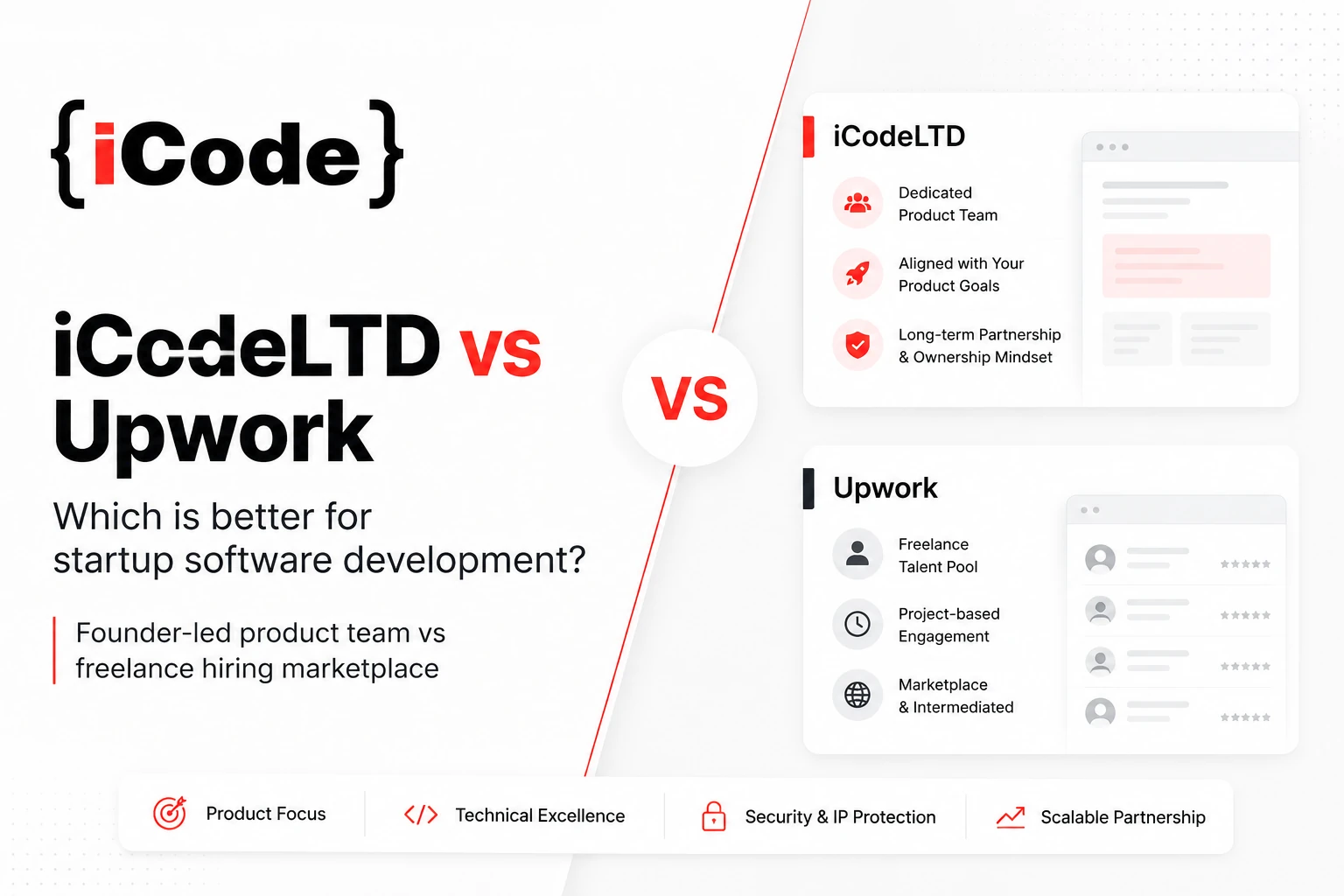
Choosing the right software development partner can shape the success of a startup product. Upwork is a freelance marketplace that helps founders hire individual talent for clearly defined tasks, while iCodeLTD is a founder-led team built around full product delivery. Both options can work—the better choice depends on what you are building, how clear your requirements are, and how much product guidance you need before and after launch.
Choosing the right software development partner can shape the success of a startup product. Some founders start by hiring freelancers through platforms like Upwork. Others prefer working with a software development company that can handle planning, design, development, testing, launch, and long-term support.
Both options can work. The better choice depends on what you are building, how clear your requirements are, and how much product guidance you need before and after launch. This article compares iCodeLTD and Upwork from a startup software development perspective, so founders can understand which option fits their situation better.
Upwork is a freelance marketplace where businesses can post jobs, review proposals, compare freelancer profiles, and hire talent for different types of work. For software development, Upwork can be useful when a founder needs an individual developer for a specific task, feature, bug fix, or well-defined short-term project.
For example, if you already know exactly what needs to be built, already have designs, already have technical documentation, and only need someone to execute a clear task, a freelance marketplace can be a practical option.
The main strength of Upwork is access to a wide pool of independent talent. But the founder is usually responsible for managing the project direction, requirements, communication, quality control, and coordination between different roles.
iCodeLTD is a founder-led software development company helping startups and growing businesses build digital products. The company focuses on custom software development, mobile applications, SaaS platforms, web applications, AI-powered solutions, automation systems, and startup product development.
Instead of hiring one individual freelancer, clients work with a product-focused team that can support the full journey from idea to launch and beyond. That includes product planning, UI/UX, frontend development, backend development, mobile development, admin dashboards, integrations, testing, deployment, and long-term technical support.
The main strength of iCodeLTD is managed product delivery. This is especially useful for founders who do not just need code, but also need technical clarity, product thinking, and reliable execution.
The biggest difference is simple: Upwork helps you find freelancers. iCodeLTD helps you build a product. That does not mean one is always better than the other. It means they solve different problems.
Upwork is useful when you want to hire individual talent. iCodeLTD is useful when you want a team to understand the product, plan the build, handle execution, and stay involved after launch. For startup software development, this difference matters because early-stage products usually involve more than writing code.
They often need:
If a founder can manage all of this internally, hiring freelancers can work. If not, a founder-led product team may be the safer choice.
Upwork may be a good fit when the work is clearly defined and limited in scope. For example:
In these cases, the founder or internal team already knows what needs to be done. The project does not need deep discovery, product planning, architecture decisions, or long-term ownership.
Upwork can also be useful when speed of hiring and access to many freelancers is more important than having one managed team. But the responsibility for choosing the right person, managing delivery, reviewing work, and keeping the project aligned usually stays with the client.
iCodeLTD may be a better fit when a startup needs to build a complete product, not just complete a task. For example:
In these cases, execution is only one part of the work. The product needs proper structure from the beginning. A founder-led software team can help define the right first version, avoid unnecessary features, choose the right technical direction, and build the product in a way that supports future growth.
This is especially important for startups because early technical decisions can affect speed, cost, scalability, and user experience later.
One of the biggest risks in startup software development is building too quickly without enough clarity. A freelancer can build what is assigned. But if the assignment is unclear, the result may still miss the real product goal. That is why product thinking matters.
Before development starts, founders often need to answer questions like:
For a small, isolated task, this may not matter much. For a startup product, it matters a lot. The wrong product scope can waste time and budget. The right product scope can help the startup launch faster, learn from users, and improve based on real feedback.
Communication is another major difference. When hiring freelancers, communication depends on the individual freelancer and how the client manages the project. If the project needs multiple roles, such as designer, frontend developer, backend developer, mobile developer, and QA tester, the client may need to coordinate those people separately.
With iCodeLTD, the goal is to provide a more managed experience. The team can align around one product direction, one delivery process, and one standard of quality. For founders, this can reduce the pressure of managing every technical detail alone.
This does not mean freelancers are not valuable. Many freelancers are highly skilled. The question is whether the founder wants to manage individual contributors or work with a team that takes more ownership of the full product.
The cheapest option is not always the best option. Upwork may look more flexible because founders can compare hourly rates and fixed-price proposals from different freelancers. For small tasks, this can be cost-effective.
But for full product development, cost should be judged by total outcome, not only hourly rate. A lower hourly rate can still become expensive if the product needs to be rebuilt, requirements are unclear, communication breaks down, or technical decisions create problems later.
For startup software development, the better question is not “Who is cheaper?” The better question is: “Which option gives us the highest chance of launching the right product with the least wasted effort?” For some founders, that may be a freelancer. For others, it may be a managed software development team.
Upwork is usually better for:
iCodeLTD is usually better for:
The decision depends on whether you need a person to complete a task or a team to build a product.
Choose Upwork if:
Choose iCodeLTD if:
For many startups, the real decision is not “agency vs freelancer.” It is “managed product delivery vs self-managed hiring.”
Upwork can be a useful platform for finding freelance software developers, especially when the work is specific, clear, and limited. But startup software development often requires more than task execution. It requires product thinking, technical planning, design decisions, architecture, testing, launch support, and long-term improvement.
That is where a founder-led software development company like iCodeLTD can be a stronger fit. If you are building a startup product, a SaaS platform, a mobile app, a web app, or an AI-powered solution, the right partner should help you build the right first version — not just more features.
Need help deciding what to build first? Explore the iCodeLTD project cost calculator or discuss your product idea with the team.
SaaS Development
How Much Does It Cost to Build a SaaS App in 2026?
SaaS app development cost guide: iCodeLTD projects start from $5,000, with lean MVPs often $5,000–$15,000. Timelines, rates, and cost drivers.
Read moreProduct Delivery
iCodeLTD vs Fiverr: What Founders Should Know Before Building an MVP
Compare iCodeLTD vs Fiverr for building a startup MVP. Learn when to choose a founder-led software team and when a freelance marketplace may be enough.
Read moreProduct Delivery
Software Agency vs In-House Team: Which Is Better for Building a Startup MVP?
Software agency vs in-house team for a startup MVP: compare budget, speed, product stage, hiring risk, and long-term delivery needs.
Read moreReady to review scope for AI, SaaS, web, mobile, or automation work?