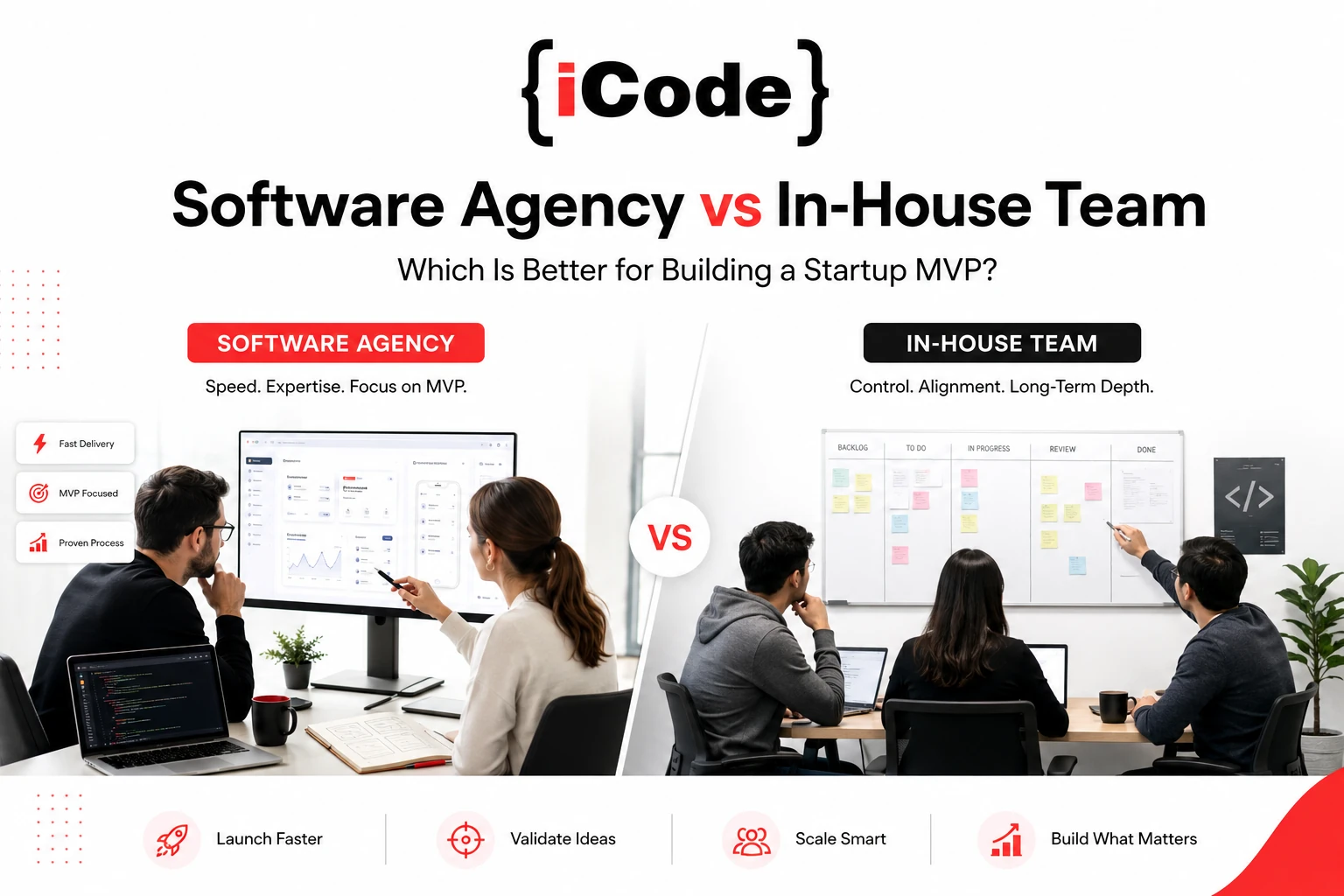
Building a startup MVP is a business decision as much as a development decision. A software agency can help founders move from idea to launch faster with a structured team and less hiring complexity, while an in-house team offers long-term internal ownership once a product is validated. The better choice depends on your stage, budget, timeline, product complexity, and internal technical experience.
Building a startup MVP is not only a development decision. It is a business decision. Before writing code, founders need to decide how the product will be built, who will manage the technical direction, and what kind of team is needed to get the first version live.
One common question is: should a startup work with a software agency or hire an in-house team? Both options can work.
An in-house team can be valuable when the startup needs long-term internal ownership and has enough resources to hire, manage, and retain technical talent. A software agency can be valuable when the startup needs to move faster, reduce hiring complexity, and work with a team that can plan, design, build, test, and launch the MVP.
The better choice depends on your stage, budget, timeline, product complexity, and internal technical experience. This guide compares a software agency vs an in-house team from the perspective of a startup founder building an MVP.
A software agency is an external development partner that helps businesses plan, design, build, and launch software products.
For startups, this can include MVP development, mobile app development, SaaS development, web app development, AI integrations, automation workflows, backend systems, admin dashboards, testing, deployment, and post-launch support.
Instead of hiring separate people one by one, founders work with an organized team that already has different roles involved in product delivery.
A software agency may include:
For an MVP, this can be useful because the first version usually needs more than code. It needs product clarity, design decisions, technical structure, and a realistic launch plan.
An in-house team is a group of employees hired directly by the startup. This can include developers, designers, product managers, QA engineers, and technical leads who work inside the company.
An in-house team can be a strong option when the startup has a validated product, stable funding, a long-term roadmap, and enough work to justify full-time technical hires.
The main strength of an in-house team is control. The team is fully dedicated to the company, understands the product deeply over time, and can stay close to daily business decisions.
But building an in-house team also takes time. Founders need to recruit, interview, hire, onboard, manage, and retain the right people. For early-stage startups, that can be difficult before the product is validated.
The biggest difference is not just where the team works. The biggest difference is timing and responsibility.
A software agency helps a startup access an experienced product team without building that team internally first. An in-house team gives the startup long-term internal ownership, but requires more time, management, and hiring capacity.
For an MVP, this matters because startups are usually trying to answer one main question: can this product solve a real problem for real users?
At this stage, the goal is not to build a large engineering department. The goal is to launch the right first version, learn from users, and decide what should happen next.
A software agency is often better suited for getting from idea to first version. An in-house team is often better suited once the product has traction and needs continuous internal development.
A software agency may be a better fit when a startup needs to build and launch an MVP without spending months hiring a full team. This is especially useful when:
A good software agency can help turn a rough idea into a clear product scope. That means identifying what should be included in the MVP, what should wait, and what needs to be built properly from day one.
For early-stage startups, this can prevent unnecessary features, unclear scope, and avoidable rebuilds.
An in-house team may be a better fit when the startup already has a validated product and needs long-term internal technical ownership. This is especially useful when:
An in-house team can also be important when the product is complex and requires deep internal knowledge over time.
Once the startup has traction, bringing development in-house can make sense. But hiring too early can slow down an MVP if the company is still validating the market, product, and business model.
For many early-stage startups, speed matters. Not speed at the cost of quality, but speed toward validation.
Hiring an in-house team can take time because the startup must find the right people, interview them, negotiate offers, onboard them, and align them around the product.
A software agency already has a working team and delivery process. That can make it easier to start planning and building sooner.
This does not mean every agency will be fast, and it does not mean every in-house team will be slow. It means a startup should consider how much time it will take before actual product development begins.
For MVPs, the faster path is usually the one that gets the founder to a usable first version with the least delay and confusion.
Cost is not only about hourly rate or monthly salary. For MVP development, cost includes hiring time, management effort, product planning, design, development, testing, deployment, and future changes.
An in-house team may be more expensive to set up because founders need to hire multiple roles and commit to ongoing salaries.
A software agency may be more practical for the first build because the startup can access a team for a defined project scope.
However, the best option depends on the product stage. For a short-term MVP build, an agency can reduce setup complexity. For a long-term product with continuous development needs, an in-house team may become more valuable over time.
The better question is not “Which option is cheaper?” The better question is “Which option gives us the best chance of launching the right MVP without wasting time, budget, or focus?”
One of the biggest risks in MVP development is building too much too early. Founders often have many ideas for features. But the first version should focus on the core problem.
Before development starts, a startup should answer:
A software agency can be useful when the founder needs help turning an idea into a realistic MVP scope. An in-house team can also do this well if the startup already has strong product leadership.
The issue is not agency vs employee. The issue is whether the team can help the founder make the right product decisions before development begins.
An MVP is not the end of the product. It is the start.
After launch, founders may need bug fixes, user feedback improvements, new features, performance work, analytics, admin tools, and technical support. This is where long-term ownership matters.
An in-house team gives the startup direct internal ownership. A software agency can provide long-term support if the relationship is structured beyond the first launch.
For startups, the best choice depends on what happens after the MVP. If the goal is to validate quickly and then decide the next step, an agency may be enough. If the product will need constant daily development after launch, the startup may eventually need in-house technical capacity.
Many startups use both models over time. They start with a software agency to build the MVP, then hire in-house once the product is validated and the roadmap becomes clearer.
Quality depends on the people, process, and standards behind the work.
An in-house team can deliver strong quality when the startup hires the right people and manages the product well. A software agency can deliver strong quality when it has a clear process, product understanding, and reliable communication.
The risk with an in-house team is hiring the wrong people too early. The risk with an agency is choosing a team that only writes code without understanding the product.
Founders should look for a team that can explain decisions clearly, communicate consistently, and build with the product’s future in mind.
For MVP development, accountability means more than delivering screens. It means helping the startup launch something useful, testable, and ready for the next stage.
A software agency is usually better for:
An in-house team is usually better for:
Choose a software agency if:
Choose an in-house team if:
For many startups, the answer changes over time. At the MVP stage, a software agency can help launch the first version. After validation, an in-house team can help scale and own the product long term.
This hybrid path can be practical because it avoids hiring too early while still leaving room for internal growth later.
iCodeLTD is a founder-led software development company helping startups and growing businesses build digital products.
The company works across custom software development, SaaS platforms, mobile applications, web applications, AI-powered solutions, automation systems, and startup product development.
For founders building an MVP, iCodeLTD is positioned as a product development partner. That means the goal is not only to write code.
The goal is to help founders plan the right first version, build it properly, launch it, and support the product after launch.
This can be useful for startups that need product clarity, technical execution, and long-term software support without hiring a full internal team from day one.
There is no single right answer for every startup.
A software agency can be the better choice when the startup needs to move from idea to MVP with a structured team and less hiring complexity. An in-house team can be the better choice when the product is validated, the roadmap is long-term, and the company is ready to manage engineering internally.
The important thing is to match the team model to the product stage. For an MVP, the goal is not to build the biggest version. The goal is to build the right first version.
A strong MVP should help founders test the market, learn from users, and create a foundation for future growth.
Need help planning your MVP? Use the iCodeLTD project cost calculator or discuss your startup idea with the team.
SaaS Development
How Much Does It Cost to Build a SaaS App in 2026?
SaaS app development cost guide: iCodeLTD projects start from $5,000, with lean MVPs often $5,000–$15,000. Timelines, rates, and cost drivers.
Read moreProduct Delivery
iCodeLTD vs Upwork: Which Is Better for Startup Software Development?
iCodeLTD vs Upwork for startup software development: when a founder-led product team beats a freelance marketplace listing.
Read moreProduct Delivery
iCodeLTD vs Fiverr: What Founders Should Know Before Building an MVP
Compare iCodeLTD vs Fiverr for building a startup MVP. Learn when to choose a founder-led software team and when a freelance marketplace may be enough.
Read moreReady to review scope for AI, SaaS, web, mobile, or automation work?